
Enterprise Adoption Starts Where Most AI Demos End

Enterprise Adoption Starts Where Most AI Demos End

|

By

Anirban De

July 10, 2026

Why usability, governance, and operational readiness decide what survives contact with production.

Picture the room.

The pilot went well. Business users are typing real questions and getting real, governed answers back in seconds. The demo everyone worried about landed. Then someone from the security team leans back and asks the one question that has killed more AI pilots than any flaw in the model itself:

“How do we know who saw what?”

That question is not hostile. It is the job. And it is where Part 1 and Part 2 of this series were always heading.

Part 1 argued that the enterprise bottleneck is access, not storage. Part 2 followed the machinery that makes governed access real: MCP connectors instead of one-off integrations, a query composer grounded in actual schema, an executor hardened against the quiet ways cross-source joins fail, masking and lineage that follow sensitive fields wherever they travel, a presentation layer that doesn’t smuggle raw rows into a prompt.

None of that survives a security review on its own. A pipeline can be technically sound and still get killed in procurement because nobody can answer “who saw what,” “what happens if this goes down,” or “who owns this once the pilot team goes on leave.” This post (Part 3) is about that gap — not whether DataTalk is impressive, but whether it can be run responsibly, indefinitely, by people who did not build it.

Enterprise AI adoption does not fail because the demo was weak. It fails because the operating model was.

Usability Is Not a Soft Concern

In enterprise software, usability is routinely filed under “nice to have,” well behind architecture and security. That ordering is backwards.

If a governed system is harder to use than the workaround, people find the workaround. That is not a hypothetical — it is the default outcome of every access-control program that ignores the user’s actual path of least resistance. The moment someone exports a report to a spreadsheet just to avoid five more clicks or pastes a customer list into an ungoverned chat tool because it is faster than requesting access, the governance program has already lost. Not to malice. To friction.

DataTalk treats usability as part of control, not a coat of paint over it. Natural language lowers the barrier to ask a question. Context-aware presentation, covered in Part 2, lowers the barrier to understand the answer. Administrative tooling lowers the barrier to operate the system day to day. None of these are cosmetic. A system earns the label “enterprise-ready” the moment the intended path is easier than the shortcut around it.

Security Has to Live in the Product, Not Just the Architecture

Part 2 covered what happens to a request in flight — RBAC and ABAC decide what a query is allowed to touch, and masking decides what survives the trip back. What it did not cover is how those rules get set, reviewed, and trusted at the perimeter, before a question is ever composed into a query.

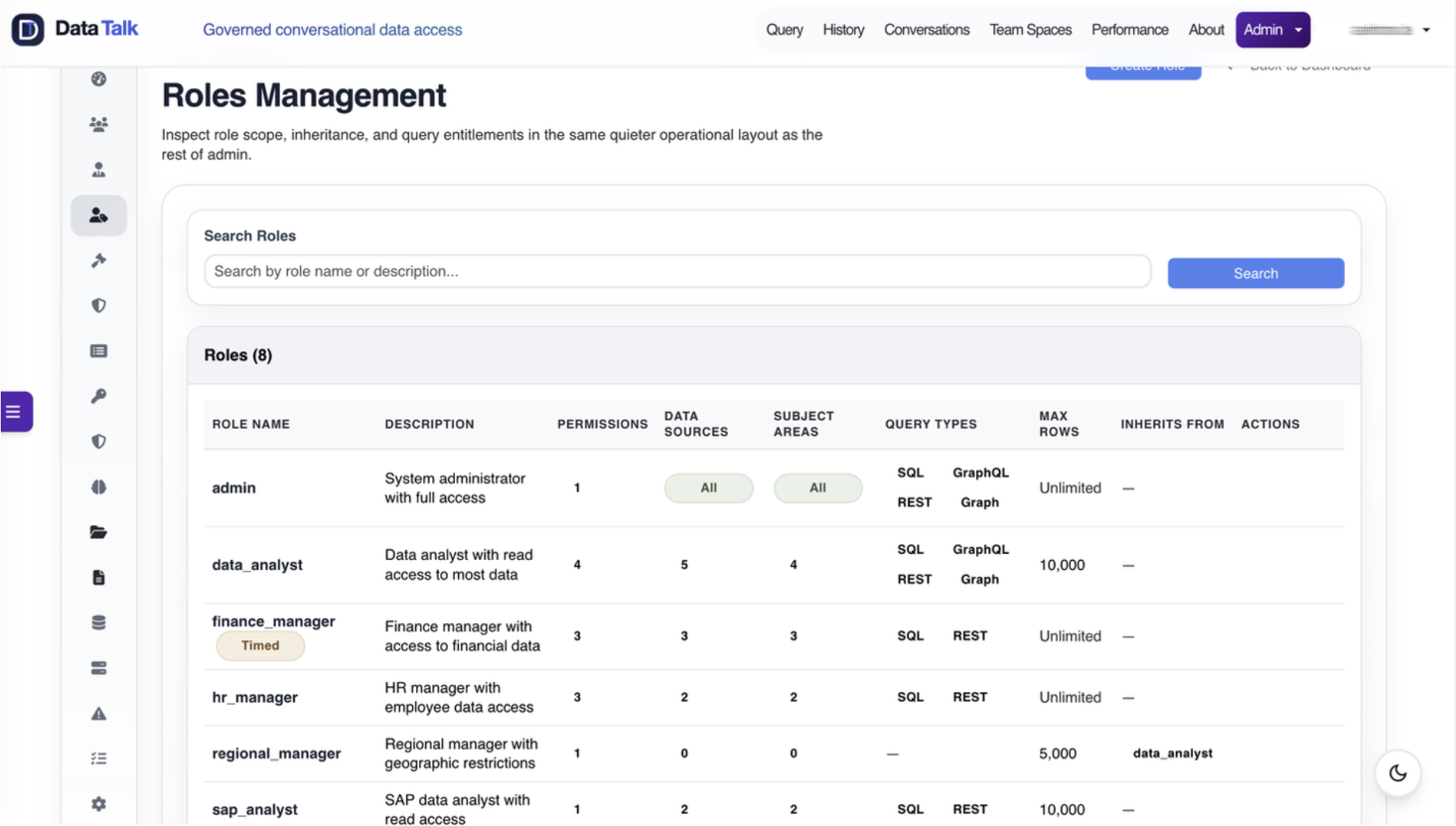
In DataTalk, roles and policies are declarative. An administrator defines a role — say, data_analyst — with the query types it can run, the data sources it can reach, and the subject areas it can see, in version-controlled configuration rather than scattered across application code. That distinction matters more than it sounds like it should: policy that lives in a reviewable config file is policy a security team can audit before go-live, not tribal knowledge that lives in one engineer’s head.

Identity doesn’t get reinvented either. DataTalk authenticates through SAML 2.0 and OIDC against the identity provider the organization already runs — instead of asking security teams to stand up a parallel user directory for one more tool. One fewer new attack surface is itself a security feature, and it is usually the difference between a security sign-off measured in days versus quarters.

Underneath both sits the same discipline noted in Part 2: when a policy or masking decision cannot be evaluated with confidence, the system fails closed. Ambiguity results in withheld data, never exposed data. That principle must hold at the identity layer and the policy layer just as strictly as it holds inside the query pipeline.

Every Query Leaves a Trail

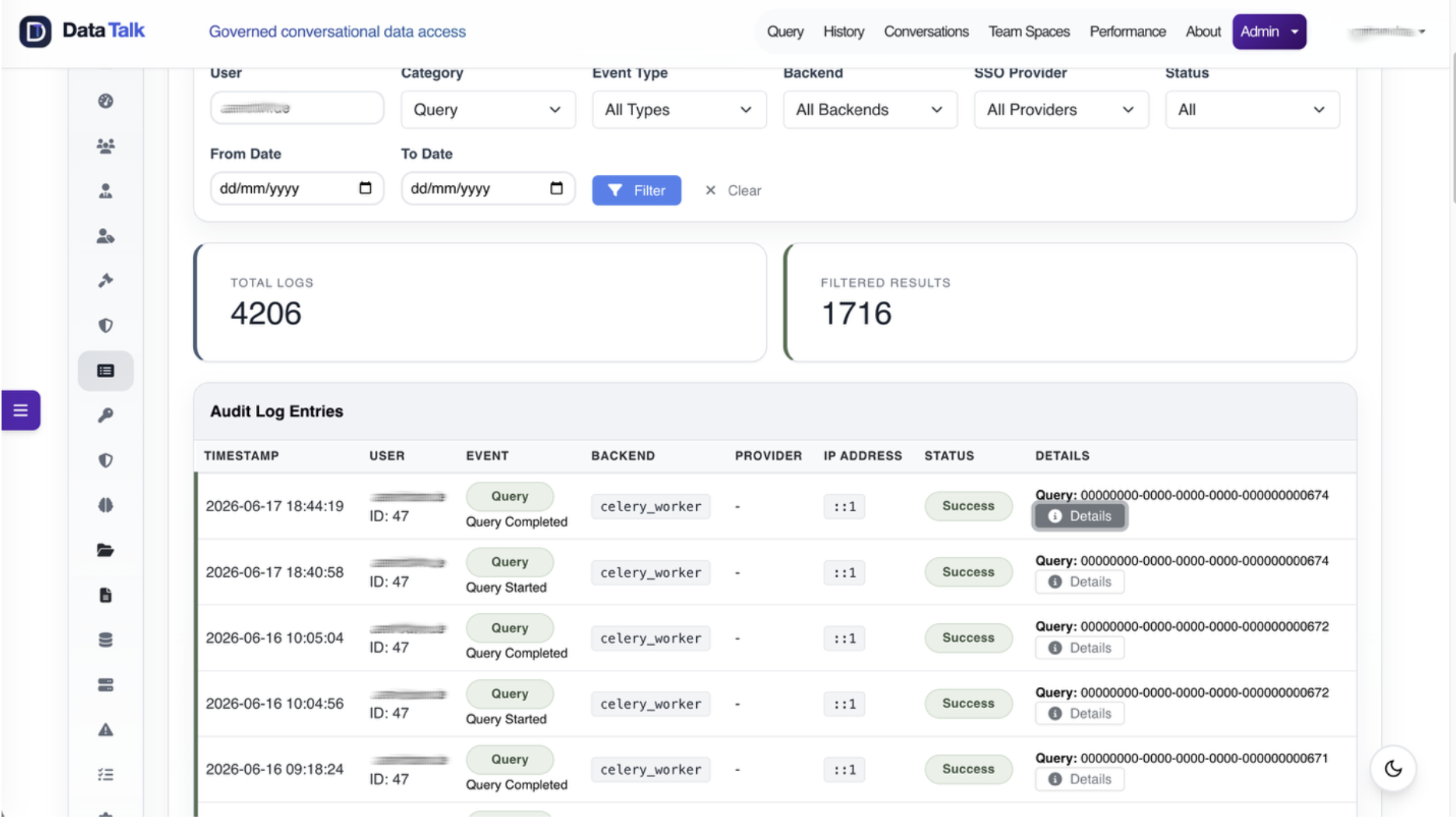
Governance that cannot be inspected after the fact is governance on faith. DataTalk logs activity as a first-class, structured record rather than scattered application logs someone must reconstruct after an incident.

Every authentication attempt, query, permission decision, and collaboration action land in a unified audit trail — who, what, when, from where, through which identity provider, and whether it succeeded. A permission that was denied is recorded with the same rigor as one that was granted. That record is filterable and searchable in the admin console, and exportable, so a compliance review does not require pulling an engineer off a sprint to write a one-off query against production logs.

That is a small, unglamorous fact with an outsized effect on adoption. It turns “trust us” into “here is the log, filtered to your team, for the last quarter.” Security and compliance teams do not need to take DataTalk’s word for how the system behaved. They can read it.
Production Readiness Is Operational, Not Rhetorical

“Production-ready” is one of the most overused phrases in enterprise software. What it should mean is narrower and more concrete: can this be deployed, scaled, monitored, and handed off without improvisation.

DataTalk’s deployment topology is built for that handoff rather than for a demo laptop. Background work is split across priority queues, so a routine query and a heavyweight enterprise workload don’t compete for the same worker pool. The production configuration adds a reverse proxy, replicated caching and database layers for resilience, and monitoring and log aggregation, so an operations team inherits something observable rather than a black box that either responds or doesn’t.

The same governance also travels with the user regardless of how they show up. Whether a question arrives typed into the web interface, issued from the command line by an administrator scripting a policy check, or spoken aloud through the voice channel, it passes through the same authorization and audit path. An admin does not maintain three different security models for three different front doors — and a security reviewer does not have to ask, “does the voice channel bypass any of this?” The honest answer is no, by construction, because there is only one governed path in.

That is what separates infrastructure from a feature list. A feature list describes what a product can do in a demo. Infrastructure describes what still holds true at 2 a.m. when nobody who built it is watching.

The System Gets Smarter Without Getting Looser

Adoption tends to erode governance in one of two predictable ways: collaboration features that widen who see an answer without re-checking who is allowed to see it, and usage that grows unmetered until a query storm hits a source system or a bill arrives that nobody can explain.

DataTalk addresses both failure modes squarely. When a team shares a thread of governed answers in a workspace, authorization is re-evaluated for every viewer on every response — not cached at share time — so a colleague without access to a masked field never sees it just because someone else on the team could. When usage scales, per-user and per-source quotas are enforced before a request is even dispatched, in configurable hard, soft, or advisory modes, so one runaway query or one overeager pilot user cannot quietly overload a production ERP system or blow through a budget nobody was watching.

There is a third piece worth naming because it’s easy to get backwards: DataTalk also improves from feedback, but not by letting live production queries teach the model unsupervised. Users can rate the answers they get; those ratings and the masked context around them are reviewed before anything is promoted into the examples the query composer draws on. The system gets better at the questions your organization asks, on a human-reviewed timeline — not by learning from whatever happened to run in production last Tuesday.

None of this is what makes a demo impressive. It’s what makes a rollout survive its second and third year, after the novelty wears off and the usage patterns nobody predicted show up.

Why Usability and Security Have to Reinforce Each Other

Most AI products get this balance wrong in one of two directions. Some optimize for openness first and promise governance later — they spread fast, then run into the security objection that ends the pilot. Others optimize so hard for control that using the system becomes its own project, and adoption collapses under the friction before governance is ever tested at scale.

The better path is narrower: make the governed path the easy path. Users should be able to ask a plain question and act on the answer. Administrators should be able to enforce policy through configuration, not custom code, without breaking the experience. Security teams should be able to see what happened, in a log they can read themselves, instead of reconstructing it after something goes wrong. When those three things are true at once, adoption stops being a leap of faith and becomes a manageable decision.

Enterprise Rollout Should Be Deliberate

None of this requires a big-bang deployment to prove value, and it shouldn’t be attempted as one. The rollout pattern that works is narrower and more disciplined:

  • Start with one defined team and the roles that already describe what they’re allowed to see.
  • Connect a small number of approved sources through a governed connector — not the whole data estate on day one.
  • Turn on audit export in week one, not after an incident makes it urgent.
  • Let the security team read the logs before they ask to.
  • Expand sources, roles, and users as trust and audit history accumulate — not on a fixed calendar.

This is how governed platforms earn a larger footprint: not by promising that governance is frictionless, but by making each stage of expansion a decision backed by evidence instead of a hope.
The Business Case Is Bigger Than Convenience

When this works, the benefit is not just that business users can type questions in plain English.

The deeper shift is organizational. Business teams get answers on the timescale the question mattered on. Analysts spend less time as human routers for repetitive requests. IT gets a controlled self-service model instead of an ever-growing queue of one-off exceptions. Security and compliance teams get oversight from day one instead of inheriting risk after adoption has already outrun their visibility. Leadership gets a more responsive decision-making culture without adding another tool nobody fully trusts.

That is not a productivity anecdote. It is a change in how decisions move through the organization — and it only holds if every one of the groups above can independently say yes.

What EGIRA Promised, DataTalk Proves

This series opened with EGIRA — the reference architecture for governed enterprise intelligence: harmonized data access, context-aware connectors, staged orchestration, and guardrails built in rather than bolted on. That was the vision.

Part 1 said the real bottleneck was access, not infrastructure. Part 2 showed the machinery that makes governed access real under the hood — not a prompt wrapper, but a pipeline with contracts between every stage. This post (Part 3) is the answer to the question both of those posts were building toward: can this successfully run in production, under the people, policies, and scrutiny that enterprise IT and security teams bring to everything they approve.

The answer is yes — not because the interface is simple, but because the complexity that matters is handled in the system, in configuration a reviewer can read and a log a compliance team can query, instead of being pushed onto the user or hidden until an incident finds it.

The data was never the problem. The last mile was. This is what closing it, safely, and for good, requires.

Where to Start

If your organization already has the data but still turns simple business questions into multi-day requests, that is the gap DataTalk was built to close — and by now you’ve seen the whole argument, not just the pitch: the access problem, the pipeline that solves it, and the operating model that lets you run it without flinching.

The next step doesn’t require a commitment to rip out anything you already have. Pick one team. Connect one or two approved data sources. Define the roles and masking rules up front and turn on audit visibility from day one. Expand only as confidence builds.

If you want to talk through what that first pilot would look like for your environment, reach out to us. Bring the systems you already have. We’ll show you the last mile — and how to close it.


Anirban De
SVP - Data Practice & CoE
|
July 10, 2026

Leave a Reply

Thank you! Your submission has been received!
Oops! Something went wrong while submitting the form.

Stay Ahead of Tech Trends.

blogs  |
July 10, 2026

Enterprise Adoption Starts Where Most AI Demos End

Why usability, governance, and operational readiness decide what survives contact with production.

Picture the room.

The pilot went well. Business users are typing real questions and getting real, governed answers back in seconds. The demo everyone worried about landed. Then someone from the security team leans back and asks the one question that has killed more AI pilots than any flaw in the model itself:

“How do we know who saw what?”

That question is not hostile. It is the job. And it is where Part 1 and Part 2 of this series were always heading.

Part 1 argued that the enterprise bottleneck is access, not storage. Part 2 followed the machinery that makes governed access real: MCP connectors instead of one-off integrations, a query composer grounded in actual schema, an executor hardened against the quiet ways cross-source joins fail, masking and lineage that follow sensitive fields wherever they travel, a presentation layer that doesn’t smuggle raw rows into a prompt.

None of that survives a security review on its own. A pipeline can be technically sound and still get killed in procurement because nobody can answer “who saw what,” “what happens if this goes down,” or “who owns this once the pilot team goes on leave.” This post (Part 3) is about that gap — not whether DataTalk is impressive, but whether it can be run responsibly, indefinitely, by people who did not build it.

Enterprise AI adoption does not fail because the demo was weak. It fails because the operating model was.

Usability Is Not a Soft Concern

In enterprise software, usability is routinely filed under “nice to have,” well behind architecture and security. That ordering is backwards.

If a governed system is harder to use than the workaround, people find the workaround. That is not a hypothetical — it is the default outcome of every access-control program that ignores the user’s actual path of least resistance. The moment someone exports a report to a spreadsheet just to avoid five more clicks or pastes a customer list into an ungoverned chat tool because it is faster than requesting access, the governance program has already lost. Not to malice. To friction.

DataTalk treats usability as part of control, not a coat of paint over it. Natural language lowers the barrier to ask a question. Context-aware presentation, covered in Part 2, lowers the barrier to understand the answer. Administrative tooling lowers the barrier to operate the system day to day. None of these are cosmetic. A system earns the label “enterprise-ready” the moment the intended path is easier than the shortcut around it.

Security Has to Live in the Product, Not Just the Architecture

Part 2 covered what happens to a request in flight — RBAC and ABAC decide what a query is allowed to touch, and masking decides what survives the trip back. What it did not cover is how those rules get set, reviewed, and trusted at the perimeter, before a question is ever composed into a query.

In DataTalk, roles and policies are declarative. An administrator defines a role — say, data_analyst — with the query types it can run, the data sources it can reach, and the subject areas it can see, in version-controlled configuration rather than scattered across application code. That distinction matters more than it sounds like it should: policy that lives in a reviewable config file is policy a security team can audit before go-live, not tribal knowledge that lives in one engineer’s head.

Identity doesn’t get reinvented either. DataTalk authenticates through SAML 2.0 and OIDC against the identity provider the organization already runs — instead of asking security teams to stand up a parallel user directory for one more tool. One fewer new attack surface is itself a security feature, and it is usually the difference between a security sign-off measured in days versus quarters.

Underneath both sits the same discipline noted in Part 2: when a policy or masking decision cannot be evaluated with confidence, the system fails closed. Ambiguity results in withheld data, never exposed data. That principle must hold at the identity layer and the policy layer just as strictly as it holds inside the query pipeline.

Every Query Leaves a Trail

Governance that cannot be inspected after the fact is governance on faith. DataTalk logs activity as a first-class, structured record rather than scattered application logs someone must reconstruct after an incident.

Every authentication attempt, query, permission decision, and collaboration action land in a unified audit trail — who, what, when, from where, through which identity provider, and whether it succeeded. A permission that was denied is recorded with the same rigor as one that was granted. That record is filterable and searchable in the admin console, and exportable, so a compliance review does not require pulling an engineer off a sprint to write a one-off query against production logs.

That is a small, unglamorous fact with an outsized effect on adoption. It turns “trust us” into “here is the log, filtered to your team, for the last quarter.” Security and compliance teams do not need to take DataTalk’s word for how the system behaved. They can read it.

Production Readiness Is Operational, Not Rhetorical

“Production-ready” is one of the most overused phrases in enterprise software. What it should mean is narrower and more concrete: can this be deployed, scaled, monitored, and handed off without improvisation.

DataTalk’s deployment topology is built for that handoff rather than for a demo laptop. Background work is split across priority queues, so a routine query and a heavyweight enterprise workload don’t compete for the same worker pool. The production configuration adds a reverse proxy, replicated caching and database layers for resilience, and monitoring and log aggregation, so an operations team inherits something observable rather than a black box that either responds or doesn’t.

The same governance also travels with the user regardless of how they show up. Whether a question arrives typed into the web interface, issued from the command line by an administrator scripting a policy check, or spoken aloud through the voice channel, it passes through the same authorization and audit path. An admin does not maintain three different security models for three different front doors — and a security reviewer does not have to ask, “does the voice channel bypass any of this?” The honest answer is no, by construction, because there is only one governed path in.

That is what separates infrastructure from a feature list. A feature list describes what a product can do in a demo. Infrastructure describes what still holds true at 2 a.m. when nobody who built it is watching.

The System Gets Smarter Without Getting Looser

Adoption tends to erode governance in one of two predictable ways: collaboration features that widen who see an answer without re-checking who is allowed to see it, and usage that grows unmetered until a query storm hits a source system or a bill arrives that nobody can explain.

DataTalk addresses both failure modes squarely. When a team shares a thread of governed answers in a workspace, authorization is re-evaluated for every viewer on every response — not cached at share time — so a colleague without access to a masked field never sees it just because someone else on the team could. When usage scales, per-user and per-source quotas are enforced before a request is even dispatched, in configurable hard, soft, or advisory modes, so one runaway query or one overeager pilot user cannot quietly overload a production ERP system or blow through a budget nobody was watching.

There is a third piece worth naming because it’s easy to get backwards: DataTalk also improves from feedback, but not by letting live production queries teach the model unsupervised. Users can rate the answers they get; those ratings and the masked context around them are reviewed before anything is promoted into the examples the query composer draws on. The system gets better at the questions your organization asks, on a human-reviewed timeline — not by learning from whatever happened to run in production last Tuesday.

None of this is what makes a demo impressive. It’s what makes a rollout survive its second and third year, after the novelty wears off and the usage patterns nobody predicted show up.

Why Usability and Security Have to Reinforce Each Other

Most AI products get this balance wrong in one of two directions. Some optimize for openness first and promise governance later — they spread fast, then run into the security objection that ends the pilot. Others optimize so hard for control that using the system becomes its own project, and adoption collapses under the friction before governance is ever tested at scale.

The better path is narrower: make the governed path the easy path. Users should be able to ask a plain question and act on the answer. Administrators should be able to enforce policy through configuration, not custom code, without breaking the experience. Security teams should be able to see what happened, in a log they can read themselves, instead of reconstructing it after something goes wrong. When those three things are true at once, adoption stops being a leap of faith and becomes a manageable decision.

Enterprise Rollout Should Be Deliberate

None of this requires a big-bang deployment to prove value, and it shouldn’t be attempted as one. The rollout pattern that works is narrower and more disciplined:

  • Start with one defined team and the roles that already describe what they’re allowed to see.
  • Connect a small number of approved sources through a governed connector — not the whole data estate on day one.
  • Turn on audit export in week one, not after an incident makes it urgent.
  • Let the security team read the logs before they ask to.
  • Expand sources, roles, and users as trust and audit history accumulate — not on a fixed calendar.

This is how governed platforms earn a larger footprint: not by promising that governance is frictionless, but by making each stage of expansion a decision backed by evidence instead of a hope.

The Business Case Is Bigger Than Convenience

When this works, the benefit is not just that business users can type questions in plain English.

The deeper shift is organizational. Business teams get answers on the timescale the question mattered on. Analysts spend less time as human routers for repetitive requests. IT gets a controlled self-service model instead of an ever-growing queue of one-off exceptions. Security and compliance teams get oversight from day one instead of inheriting risk after adoption has already outrun their visibility. Leadership gets a more responsive decision-making culture without adding another tool nobody fully trusts.

That is not a productivity anecdote. It is a change in how decisions move through the organization — and it only holds if every one of the groups above can independently say yes.

What EGIRA Promised, DataTalk Proves

This series opened with EGIRA — the reference architecture for governed enterprise intelligence: harmonized data access, context-aware connectors, staged orchestration, and guardrails built in rather than bolted on. That was the vision.

Part 1 said the real bottleneck was access, not infrastructure. Part 2 showed the machinery that makes governed access real under the hood — not a prompt wrapper, but a pipeline with contracts between every stage. This post (Part 3) is the answer to the question both of those posts were building toward: can this successfully run in production, under the people, policies, and scrutiny that enterprise IT and security teams bring to everything they approve.

The answer is yes — not because the interface is simple, but because the complexity that matters is handled in the system, in configuration a reviewer can read and a log a compliance team can query, instead of being pushed onto the user or hidden until an incident finds it.

The data was never the problem. The last mile was. This is what closing it, safely, and for good, requires.

Where to Start

If your organization already has the data but still turns simple business questions into multi-day requests, that is the gap DataTalk was built to close — and by now you’ve seen the whole argument, not just the pitch: the access problem, the pipeline that solves it, and the operating model that lets you run it without flinching.

The next step doesn’t require a commitment to rip out anything you already have. Pick one team. Connect one or two approved data sources. Define the roles and masking rules up front and turn on audit visibility from day one. Expand only as confidence builds.

If you want to talk through what that first pilot would look like for your environment, reach out to us. Bring the systems you already have. We’ll show you the last mile — and how to close it.

Author
Anirban De
SVP - Data Practice & CoE
Author
To know more
Contact
Recent Blogs
Blogs
May 29, 2026
The Question Took Two Seconds. Safely Joining Five Systems, Masking Sensitive Fields...
Blogs
May 5, 2026
The Last-Mile Problem in Enterprise Data Access
About Minfy
Minfy is the Applied Technology Architect, guiding businesses to thrive in the era of intelligent data applications. We leverage the power of cloud, AI, and data analytics to design and implement bespoke technology solutions that solve real-world challenges and propel you ahead of the curve. Recognized for our innovative approach and rapid growth, Minfy has been featured as one of Asia Pacific's fastest-growing companies by The Financial Times (2022) and listed among India's Growth Champions 2023. 

Minfy is a trusted partner for unlocking the power of data-driven insights and achieving measurable results, regardless of industry. We have a proven track record of success working with leading organizations across various sectors, including Fortune 500 companies, multinational corporations, government agencies, and non-profit organizations. www.minfytech.com/

Explore more blogs

Blogs
March 27, 2024
Minfy Achieves AWS Energy Competency
Blogs
March 27, 2024
Reaching Another Milestone with the Cloud Centre of Excellence
Blogs
March 27, 2024
SAP Heterogeneous Migration